Research Interests
My past research has examined how socioeconomic factors such as student loan debt and financial aid policies shape student outcomes and social mobility in the United States and abroad. Specifically, I have examined the effects of a 30-credit hour completion policy on low-income, first-generation students who received the need-based, college promise scholarship in Indiana. This single author work has been published in Research in Higher Education via Springer and was the top 10 most downloaded manuscripts in the year 2022 (ranked #8). I have also examined the impact of the COVID-19 pandemic on international students and scholars, as well as the role of cross-border higher education in shaping graduate and professional students.
My current research has explored the impact of digital transformation, specifically artificial intelligence and hybrid work, on international teaching and learning. From this work, I have co-authored and co-edited numerous books, including ChatGPT and Global Higher Education: Using Artificial Intelligence in Teaching and Learning by STAR Scholars Press (2024), Rethinking Hybrid and Remote Work in Higher Education: Global Perspectives, Policies, and Practices after COVID-19 by Palgrave Macmillan (2023), and Online Teaching and Learning in Higher Education during COVID-19: International Perspectives and Experiences by Routledge (2022). Presently, I serve as Lead Co-Editor of the Winter 2026 Special Issue on Artificial Intelligence for the Journal of Comparative & International Higher Education (JCIHE).
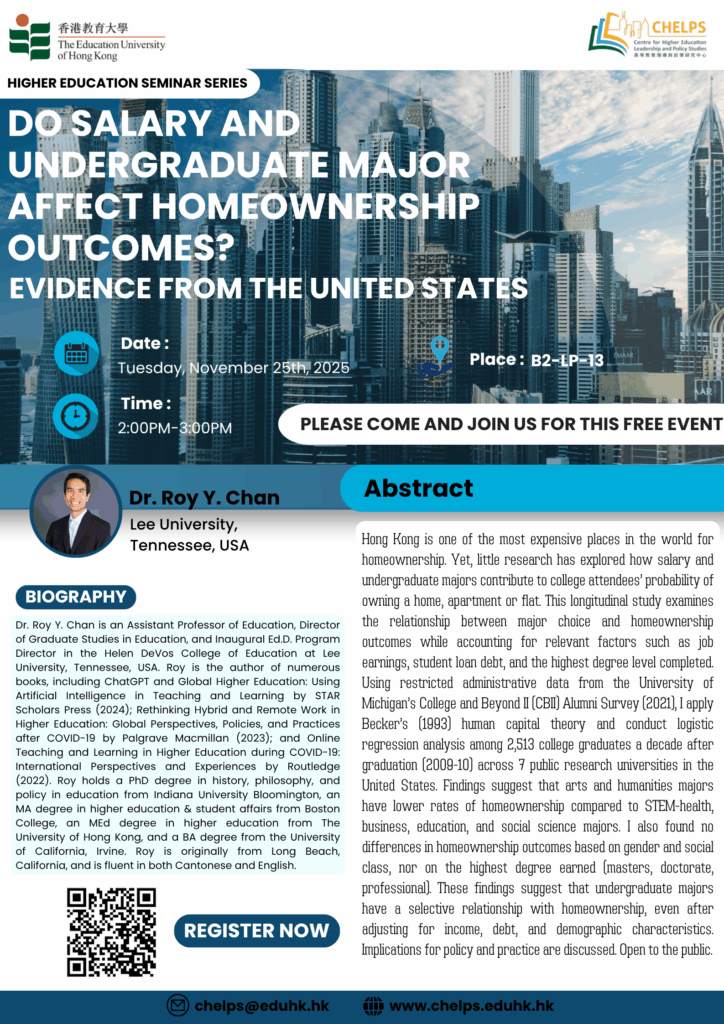
In the future, I will complete several research projects surrounding the economics of education and, more broadly, postgraduation outcomes. Specifically, I will complete a 2-year project with the University of Michigan that examines the relationships among salary, student loan debt, undergraduate major, and homeownership outcomes. The rising cost of homeownership and the growing burden of student loan debt have sparked significant debate, particularly among college graduates. Using ICSPR restricted administrative data from the College and Beyond (CBII) Alumni Survey, this quantitative study will enhance our understanding of the systemic and individual factors influencing homeownership among bachelor’s degree holders in the United States. The paper is anticipated to be published late 2026.
My second research project will explore the impact of study abroad on postgraduation civic activism. More recent adult protests have focused on movements such as Black Lives Matter, #MeToo, Stop Asian Hate, and the pro-Palestinian protests on colleges and universities nationwide. However, few empirical studies have examined whether and how these activities persisted in adulthood, long after students graduated from a university. This project will be one of the first studies in the United States to explore the effects of study abroad participation on civic activism longitudinally among 2,202 alumni at seven universities a decade after graduation (2009-2010). The paper is anticipated to be published late 2026.
Long term, I am currently building two innovate research projects: 1) developing the nation’s first Operationalizing Artificial Intelligence Identity Guide (OAIIG) to identify the major ways that institutions use AI to conduct teaching, research, and service across 200 colleges and universities worldwide, and 2) establishing the world’s first international joint and dual degree programs inventory that tack the trends and patterns of these programs, with special attention to East Asia and the Pacific.
Aside from my research projects, I currently serve on the Editorial Board for the Research in Higher Education and Journal of Postsecondary Student Success. Presently, I am the only editorial board member to serve in these tier-one academic journals from a non-elite, non-research institution, at Lee University.